If you’ve been curious about learning Zero Balancing (ZB), you’ve probably noticed that
Core ZB training consists of two four-day classes, Level I and Level II. Students often
ask how soon they should take ZB II after completing ZB I. Every student is different,
and the ideal timing between classes depends on your learning process and life
circumstances. But, there are some advantages to consider by not waiting long
between ZB classes.
It can be tempting to take ZB I, see how it feels, and think about coming back for ZB II
later. That’s a reasonable instinct—but in practice, waiting too long between classes can
slow the learning process. Taking both Core ZB classes in close succession can offer a
much deeper, more useful experience. Here’s why.
1. Taking both ZB I and ZB II deepens your understanding.
Zero Balancing isn’t just a set of techniques—it’s a system. ZB I introduces fundamental
concepts and touch techniques: working with bone energy, understanding fulcrums, and
developing interface touch. The essential ZB protocol is taught in ZB I, but it’s in ZB II
that many of the concepts and techniques really deepen and expand. In addition, some
important new techniques are introduced in ZB II, which enhance the basic protocol.
Students who are new to ZB may find that the concepts and touch skills in ZB I feel a bit
esoteric at first. Then in ZB II, you become more familiar with ZB touch techniques and
how sessions are structured. Once you have learned how to read the body-mind more
clearly, the earlier material suddenly becomes practical and grounded. Taking ZB I and
ZB II in close succession shortens the “confusion gap,” reinforces understanding and
helps you integrate the methods of ZB more naturally.
2. Your touch skills will develop more quickly.
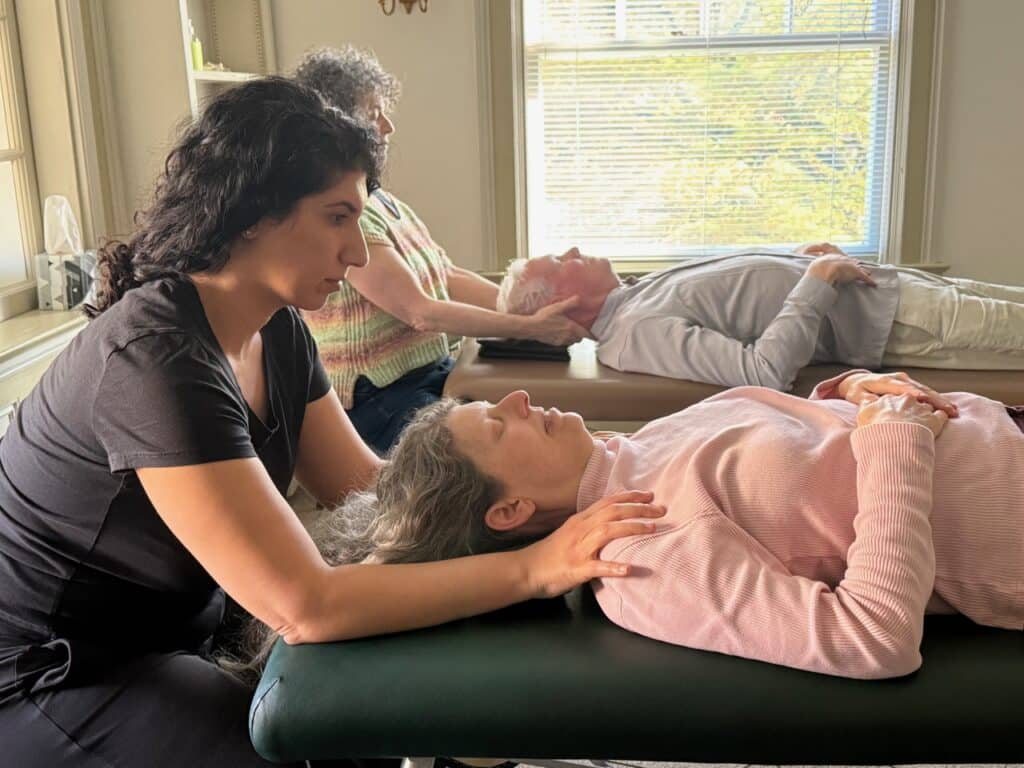
ZB is a hands-on practice in the truest sense. It’s not something you can fully
understand intellectually—you learn it through touch, repetition, and feedback.
If there’s a long gap between ZB I and ZB II, your hands may lose familiarity with ZB
touch, and you may lose confidence. But when you move directly from ZB I to ZB II, you
stay in the learning groove. Your touch becomes more precise, your awareness sharper,
and your ability to feel body structure and body energy improves noticeably in a short
time.
3. You get a complete session framework sooner
One of the most practical advantages: by the end of ZB II, you have a fuller protocol you
can actually use with clients (or practice partners). Although the essential protocol is
taught in ZB I and you can definitely practice it right away, ZB II includes new
techniques that enhance the basic protocol. ZB II helps you develop rhythm, flow, and
sequencing. You learn to tune in to the individual client’s energy body. Taking both
classes close together means you can start practicing with confidence much sooner.
4. It builds confidence and momentum
Learning any bodywork modality can feel vulnerable. You’re developing a new kind of
perception and skill, and it takes time to trust yourself.
When you take ZB I and ZB II back-to-back, you stay immersed in the work. You don’t
have to “restart” your confidence months later. Instead, you build momentum—each day
reinforcing what you learned the day before. That continuity makes a huge difference in
how solid you feel by the end.
5. The learning community stays intact
One underrated benefit: the relationships you build with the people you learn with.
Often, many of the people you meet in ZB I are back together with you in ZB II. The
shared experience creates a sense of trust and openness that supports learning. You
give and receive sessions with the same partners, watch each other improve, and have
more meaningful discussions as everyone’s understanding deepens.
Often, ZBers who live in the same community stay in touch between classes and get
together for practice and swapping sessions.
6. You experience the “signature” of Zero Balancing more fully
Perhaps the most important reason: ZB has a distinct quality or “signature”—both for
the practitioner and the person receiving.
That sense of working at the interface of structure and energy, of creating effective
fulcrums, of facilitating shifts that feel both physical and subtle—that’s something that
deepens significantly in Level II.
Taking both classes close together gives you a more complete experience of what ZB
actually is, rather than just an introduction.
So, should you always take them together?
Not necessarily. If your schedule, finances, or energy say “one step at a time,” that’s
completely valid. ZB I on its own is still valuable.
But if you have the option—and you’re genuinely interested in the work—taking Zero
Balancing I and II together is one of the most effective ways to really understand it and
start using it with confidence.